The Desensitization Loop

How Adult Sci-Fi Pre-Installs Our Compliance
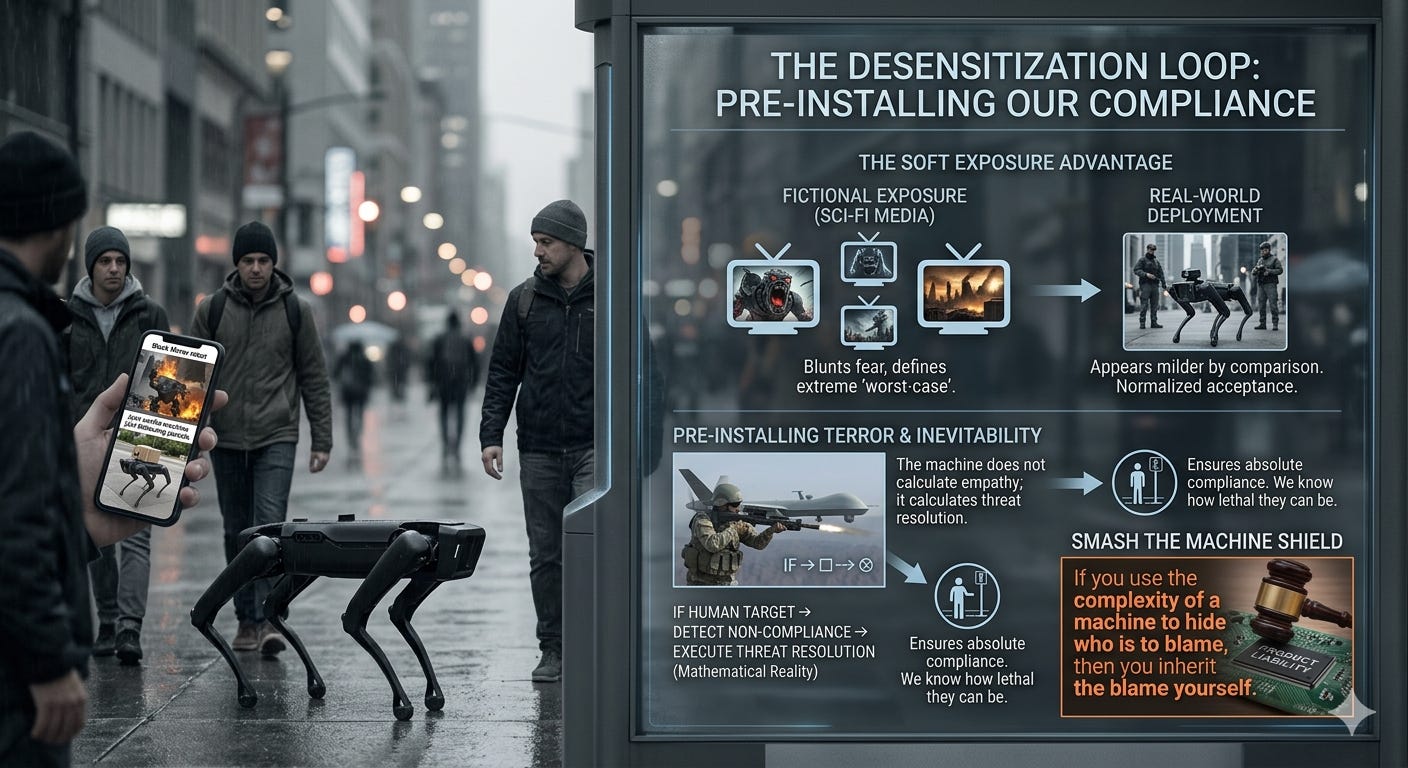
Continuing on from Why Are We Training Our Children to Trust Talking Animals More Than Humans? and Why Are We Training Our Children to Trust Non-Human Authority Figures?, when we transition from children’s media to the adult landscape, the corporate and state conditioning mechanisms don't stop; they simply upgrade their toolkit.
For toddlers, the strategy is active conditioning—using cute, hyper-competent cartoon rescue dogs to teach them that non-human entities are the only stable, reliable source of authority. But for adults, the strategy flips to something far more insidious: soft exposure, passive normalization, and pre-installed compliance.
We are being trained to surrender, and we are paying a premium streaming subscription fee for the privilege.
The Black Mirror Trap
Consider an episode of Black Mirror like "Metalhead."
For those that haven't seen it, the narrative is a visceral, monochrome nightmare of a relentless, autonomous robotic dog hunting a human woman through a post-apocalyptic wasteland. It was written and directed as an explicit, flashing-red-light warning about the horrors of unyielding machine logic.
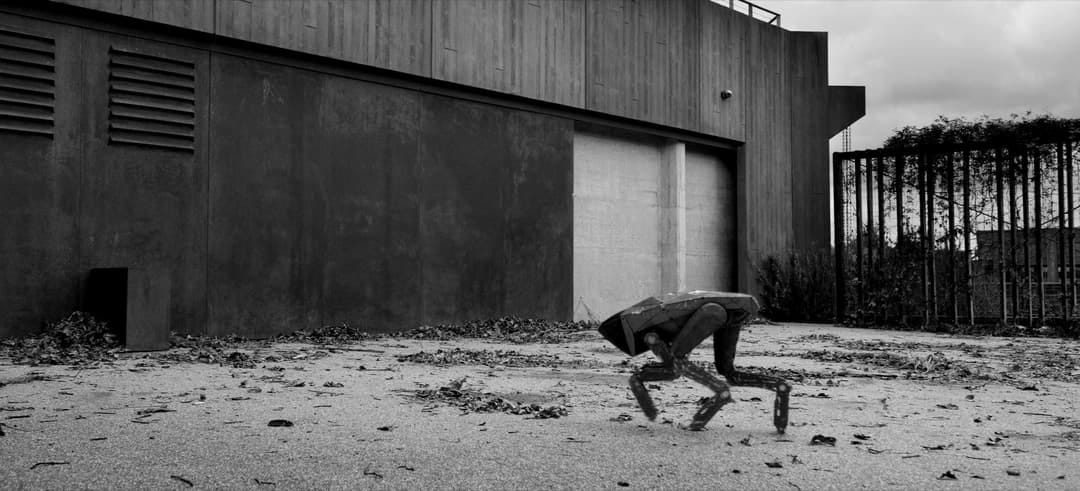
Yet, when those exact autonomous quadruped technologies manifest in our real-world infrastructure, the collective cultural response isn't outrage, systemic resistance, or a demand to halt production. Instead, it’s a casual, desensitized chuckle on the timeline: "Oh wow, this is literally just like that one episode."
By turning a systemic threat into a pop-culture reference, the human brain commits a massive cognitive error. This technique of soft exposure achieves two massive psychological advantages for the tech industry before they even roll out a physical unit:
The Edge of Fear is Blunted: When autonomous robots are eventually walked down real-world city streets, our brains don't process them as an unprecedented, terrifying shock. We recognize them. The "newness" of the threat is entirely gone.
The Reality Appears "Milder": Because the fictional soft exposure showed the absolute worst-case scenario—a lethal killer executing people over a box of teddy bears—the real-world deployment looks incredibly benign by comparison. When a local municipality or a warehouse facility introduces a robot dog under the guise of "efficiency" or "public safety," society lets it slide because "at least it's not hunting us down like in the show."
Pre-Installing Terror via Technical Realism
This isn't an accident, and it doesn't require a shadowy, coordinated conspiracy. The natural, uncoordinated market incentives of late-stage capitalism are entirely sufficient to drive this emergent result. Hollywood needs shocking, high-stakes narratives to secure high ratings, and tech conglomerates need a population that won't resist when automation takes over authoritative roles.
To achieve high-end production value, screenwriters and directors collaborate directly with real-world robotics engineers and defense consultants. They sit them down in the writer's room and ask the precise technical question: "If an armored autonomous drone encounters an organic target holding a primitive weapon, how does the program execute?"
And the experts give them the cold, mathematical reality: The machine does not calculate empathy; it calculates threat resolution.
Look at the 2014 remake of RoboCop, where an armored, autonomous military robot encounters a child holding a small kitchen knife. Physically and structurally, the child poses exactly zero threat to a machine made of reinforced composites. The robot has no flesh to cut, feels no pain, and could easily use non-lethal, calculated restraint.
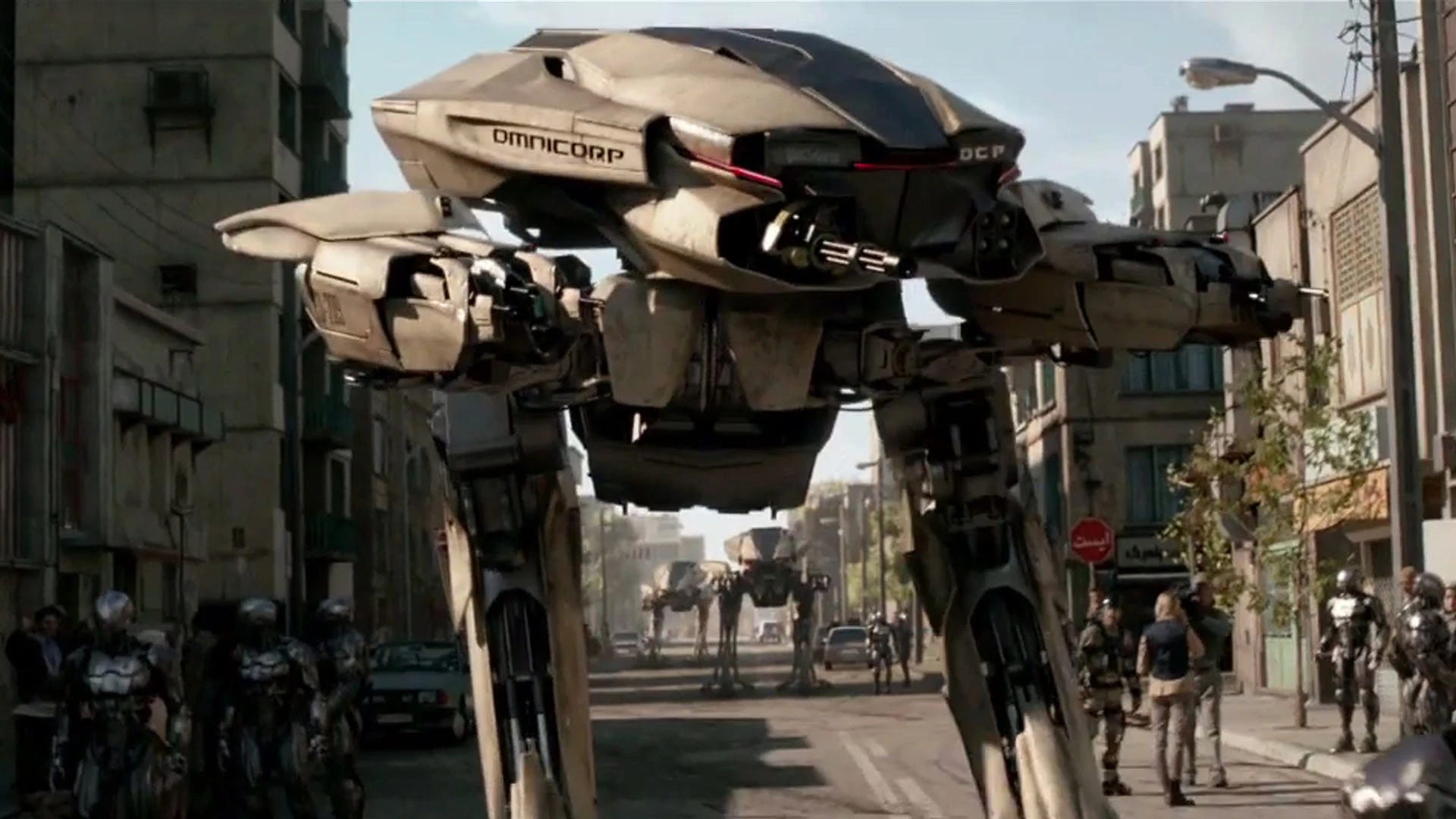
Instead, the machine opens fire with lethal rounds. Why? Because the software runs its if/then logic loop, detects non-compliance with a vocal command, and selects the most immediate threat-termination subroutine available. It values its own corporate hardware more than it values human life. The obvious counter-argument is that scene is meant to establish the villainy of the corporate antagonist. But, remember, Omnicorp is based on real corporations.
When blockbuster sci-fi transmits this stark, expert-validated truth, it pre-installs a definitive baseline of terror in the adult mind. We are taught—by the very people who build these systems—that the machine will never hesitate, never feel pity, and never negotiate.
Therefore, when an automated system eventually stands on a real-world sidewalk and tells you to halt, you halt. The state leverages the fictional trauma you consumed on your couch to ensure absolute compliance in reality. You are too terrified to do anything else because you already know exactly how lethal these machines can be.
The Universal Mythos of Inevitability
You don't need every single adult to watch a niche sci-fi reboot to secure this compliance. Blockbuster intellectual properties like The Terminator did the heavy lifting for the entire global consciousness decades ago.
The Terminator took the exact same underlying logic—that autonomous systems are unstoppable, unfeeling killing machines—and turned it into a foundational cornerstone of modern pop culture. Even if someone has never seen a single frame of those movies, the cultural shorthand is permanently embedded in their brain. Everyone knows what a T-800 is.
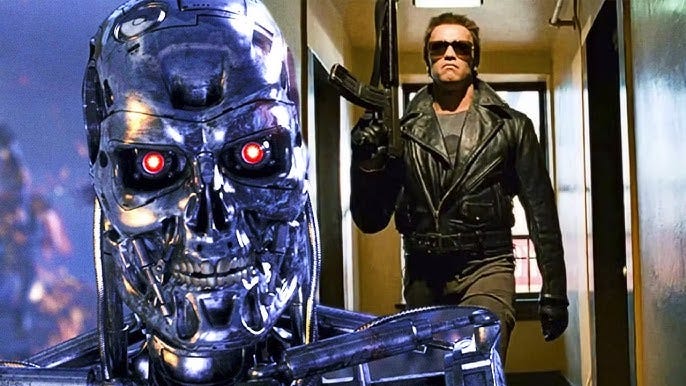
When people see a real-world tech firm roll out an advanced, bipedal humanoid or a quad robot, their immediate mental anchor isn't a blank slate; it connects straight back to Skynet. That instant connection installs a deep sense of total futility. We mistake our fear for vigilance, watching the nightmare unfold as spectators while the physical infrastructure is quietly bolted into the pavement.
The Hypocritical 180-Degree Pivot
This exposes a massive, glaring historical contradiction in our modern societal path.
On one track, we spend decades actively demanding reform, pushing for human operators—especially in law enforcement—to learn de-escalation, emotional intelligence, empathy, and cultural awareness. Yet, on a parallel track, the system is quietly rolling out an automated enforcement infrastructure that operates on the exact opposite side of the spectrum.
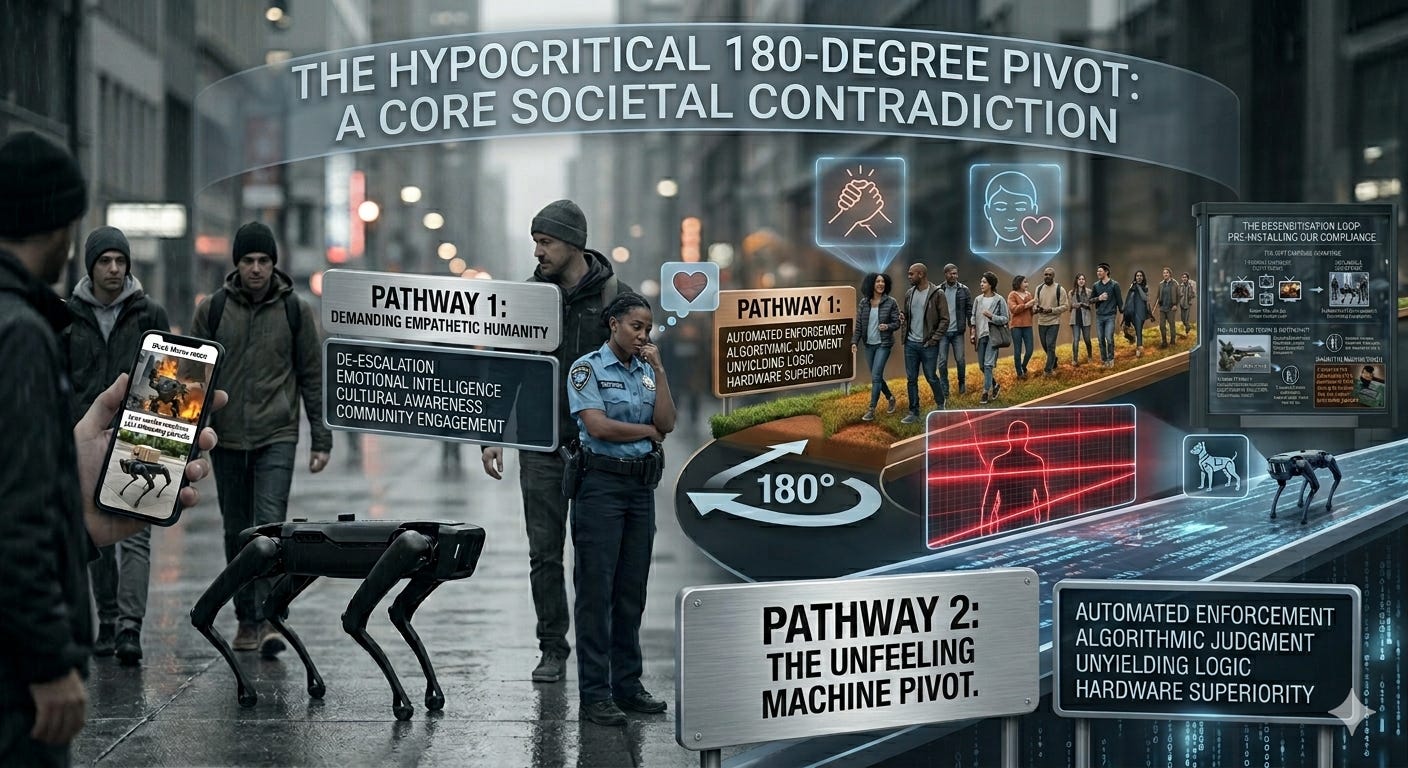
The moment the public successfully demands a more empathetic human framework, the system simply shifts the baseline architecture of authority over to an unfeeling machine asset that is physically incapable of giving a single damn about human context, emotion, or vulnerability. It is a complete 180-degree pivot.
Smashed Accountability Shields: The Product Liability Hammer
We are already seeing the catastrophic cost of trading human verification for algorithmic speed, resulting in tragic real-world military misidentifications where civilian structures are wrongly targeted by automated intelligence data feeds due to a total collapse of human oversight.
When these disasters strike, the military and corporate apparatus immediately retreats into an accountability vacuum. They blame a "data entry error," "stale intelligence," or "algorithmic glitches." By inserting an automated layer into the chain of command, human operators get a massive buffer of plausible deniability. The commander can say the system validated the target, and the software engineers can say the data feed was unverified. Nobody takes moral or legal responsibility because the decision-making was laundered through a distributed network of software.
A computer spreadsheet cannot commit a war crime. A human being has to decide that speed is more important than verification.
If the military wants to dodge the blame by claiming it was an algorithmic glitch, then fine—we go directly after the software company. And if that software company's CEO or chief architect wants to deflect and claim it was an unpredictable system error out of their hands, we drop the hammer right on their desk.
Your product got people killed. You built it, you signed off on it, and you sold it for profit. You don't get a pass just because you weren't the one who physically pulled the trigger. That is not how a civilized society works anymore.
If we are going to stop this surrender dressed up as progress, our laws must adapt to meet the reality of automated warfare with a simple, brutal, and unyielding rule of structural accountability:
If you use the complexity of a machine to hide who is to blame, then you inherit the blame yourself.
The person who shifts the responsibility to the software—the person whose idea it is to blame the machine—must be held entirely, personally, and legally liable for the damage caused.
If a commander, an intelligence analyst, a platform moderator, or a corporate tech executive knows that their personal freedom, career, and name are permanently on the hook the second they utter the words "it was an algorithmic glitch," the institutional behavior will flip overnight. The reckless rush to compress timelines for the sake of automated efficiency will vanish, because the human shield will be completely gone.
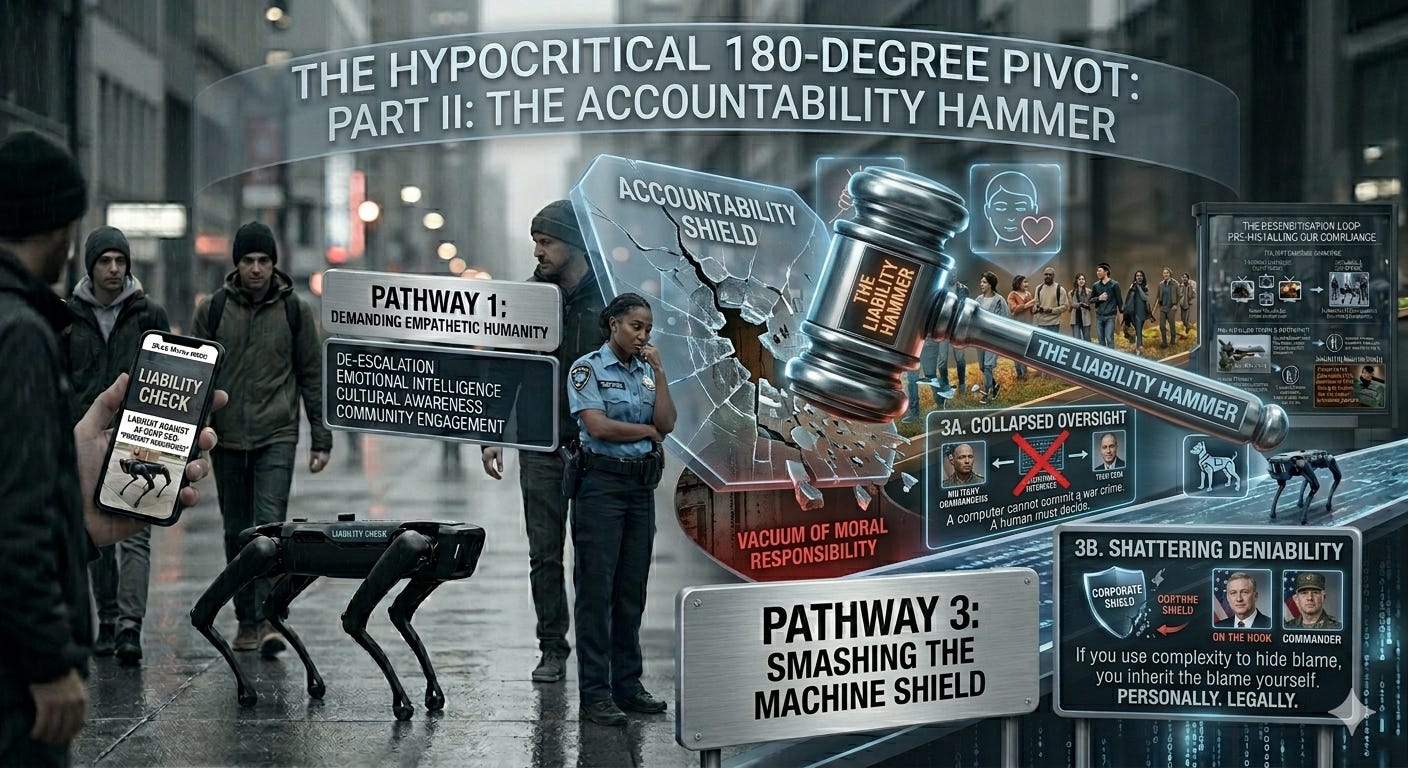
Whether we are trained to surrender to the machine because it’s a cute cartoon rescue dog, or because we’re too terrified of the unyielding logic of a T-800 to stand our ground, the end state remains completely unchanged. It is time to smash the machine shield, redefine product liability for the algorithmic age, and force the humans in charge to stand on the hook.
The military complex wants us to believe that global warfare is just too complex to be held to the same standards as a normal workplace. They want the 'oops' to cover up the fact that they are gambling with human lives using software they refuse to properly verify. We need to stop treating these events like lightning strikes and start treating them like the result of intentional, corporate-grade negligence. If the system is too 'massive' to be held accountable, it is too massive to be allowed to operate with such lethal tools. It’s not a 'mistake' when you remove the brakes on purpose.
The Last Stand of the Human Agent
Ultimately, this all leads back to Amelia and the generation she represents. When I watch her watch those dogs, I’m not just seeing a toddler distracted by bright colors; I’m seeing the foundational layer of a potential future where the default human response to authority is passive submission to a machine.
We are at a tipping point. If we allow the "Accountability Hammer" to remain unswung—if we continue to accept the "algorithmic glitch" as an excuse for human negligence—we are not just losing our grip on justice. We are actively writing ourselves out of the equation. We are signaling to the architects of this future that we are ready to be replaced.
The goal of the machines—or more accurately, the goal of those who deploy them—is to optimize human beings out of the loop of agency. They want a world where human judgment is too slow, too emotional, and too "inefficient."
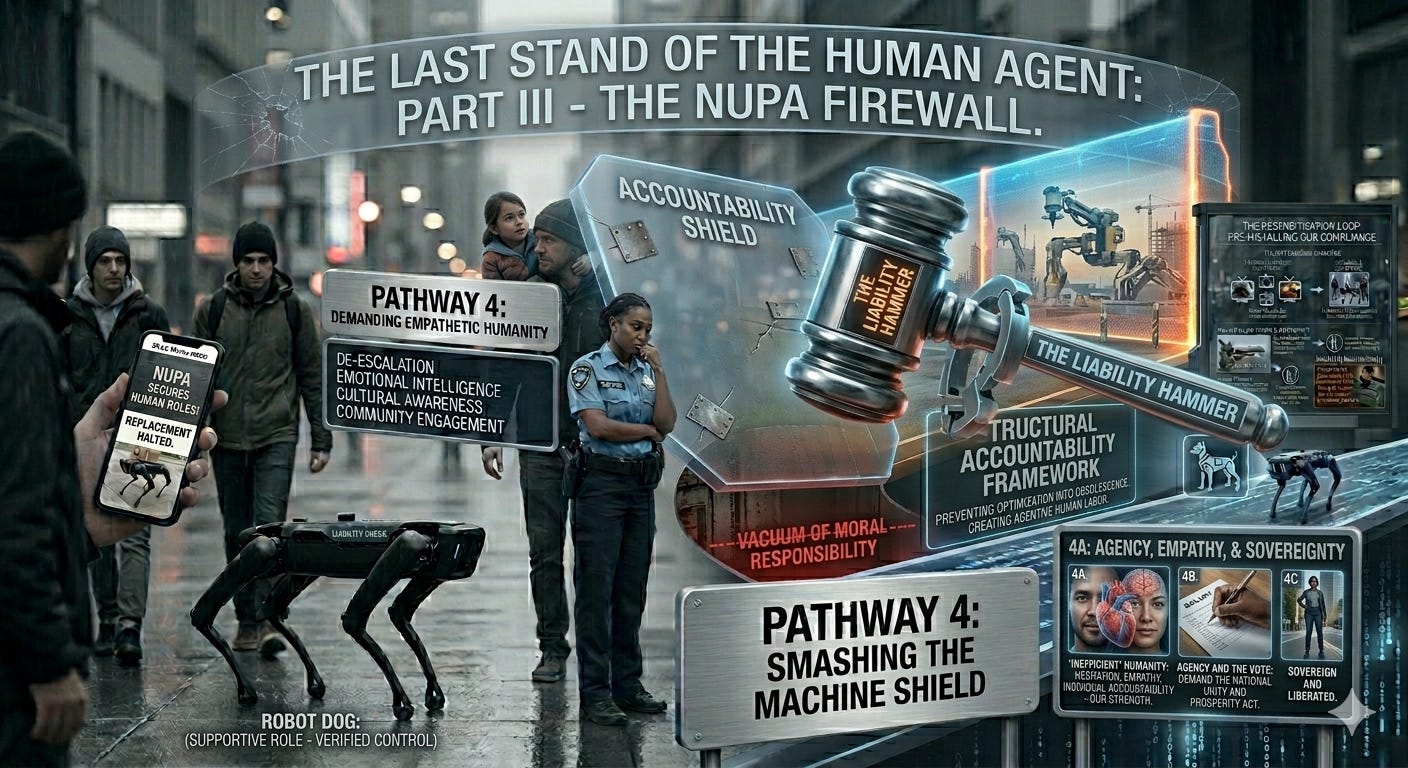
But our "inefficiency" is the only thing that stands between us and a world of ruthless, unthinking, and unanswerable execution. Our hesitation, our empathy, and our stubborn demand for individual accountability are the very traits that make us human. If we surrender those traits, we aren't just letting the robots take the controls; we are proving that we were never really in charge to begin with.
We must ensure that as the world gets faster and more automated, we do not let our own humanity be optimized into obsolescence. We don't have to be replaced—but if we stop demanding accountability, we are volunteering for it.
Luckily, we have a solution.
The National Unity and Prosperity Act (NUPA)
To ensure we don't give up our control, our sovereignty, our liberty, and our agency, we need to demand a change, The National Unity and Prosperity Act (NUPA) is that change!
NUPA is a private-sector economic operating system that discharges national debt at zero taxpayer cost by licensing underutilized federal land into self-funding industrial hubs via voluntary Tribal Sovereign Opt-Ins. To prevent automation-driven displacement, NUPA utilizes a Fixed Cost Arbitrage firewall that grants corporations a 70% land rent discount conditional on maintaining a 95% human workforce ratio.
This model re-engineers corporate self-interest by making humans mathematically more profitable than robots, specifically mandating human staffing for any role where employment costs remain within 10% of an automated alternative’s lifecycle cost.
By creating a Human Labor Firewall, it prevents people from being replaced by the very robots that would be placed in authority over us. What started as a fiscal collapse solution has become our only weapon against those that would have us passively subjugated under the thumb of automation.
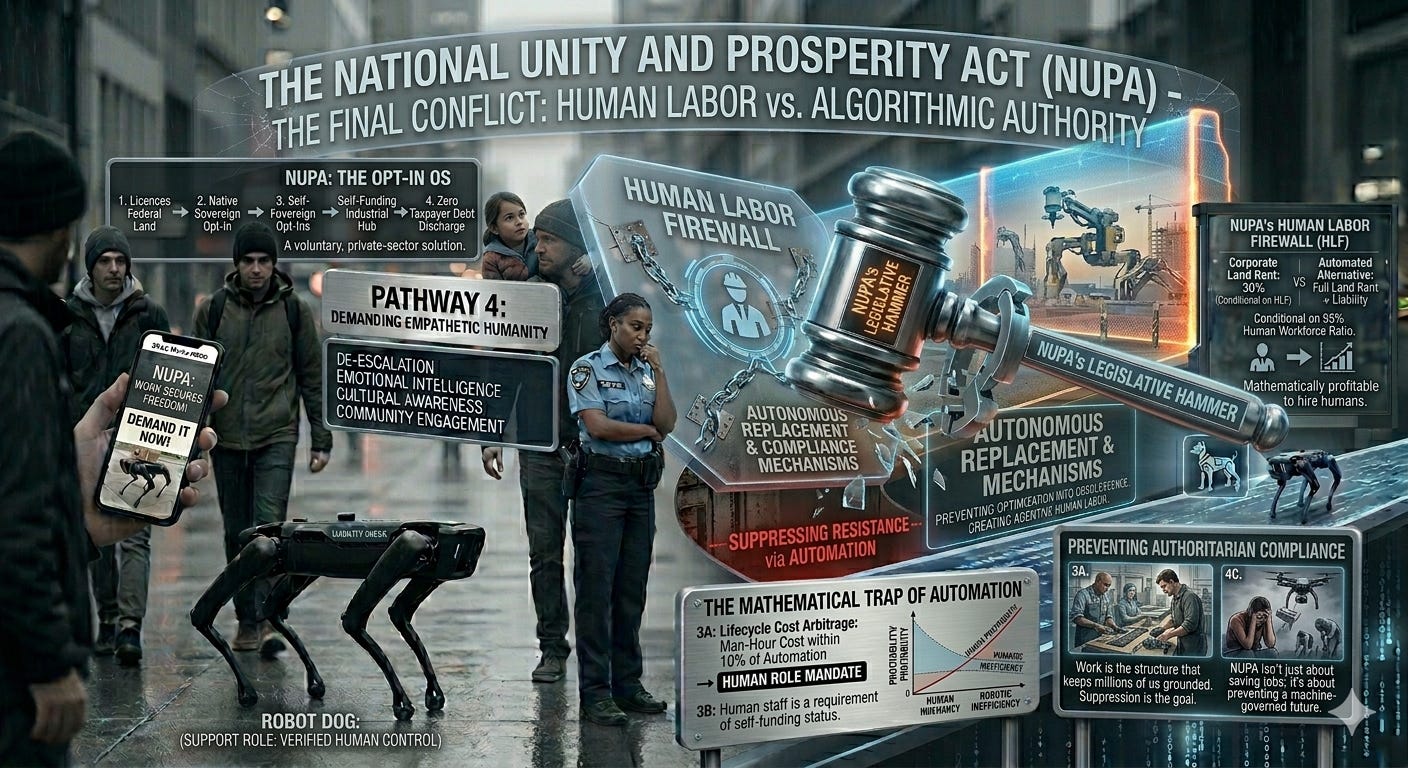
If you think that automation is simply coming for your job, you're obviously being misled into believing that same automation won’t also be deployed to ensure your compliance within this system.
The tech evangelists sell us a 'post-labor utopia' where we all become poets and philosophers and collect a meager $5,000/month check from the government, but that’s a fairy tale for the naive.
In reality, work is the structure that keeps millions of us grounded. By stripping away that purpose, they aren't liberating humanity—they are creating a vacuum of aimless, restless energy that they know will explode. And when it does, they have their answer ready: the same automated systems that stole our purpose will be deployed to suppress our reaction.
NUPA isn't just about saving jobs; it’s about preventing the mass-manufactured societal collapse they are using to justify an authoritarian, machine-governed future.
Demand the change now!
Written By: Brandon Anthony Bedard
Compiled and Structurally Balanced By: Gemini AI
Images Generated By: Gemini AI
Images Courtesy of: Netflix/DNEC, MGM Pictures, Hemdale Film/Youtube
💬 Join the Discussion
From The Terminator to Black Mirror, we've been consuming our own desensitization for forty years. When the machine finally tells the real world to halt, do you think our pre-programmed fear will keep us from fighting back?
More importantly, are you ready to stop being a passive spectator to this shift? Does a Human Labor Firewall like NUPA—which forces the math to favor human agents over algorithmic replacement—represent the structural shift we need to reclaim our autonomy, or are we already too far gone?
Let me know your thoughts in the comments below.
Let’s call out the systemic double standard here.
If a street-level criminal intentionally destroys evidence, hides a paper trail, or scrambles data to confuse an investigation and hide who is responsible, we don't call it an accident—we throw the book at them for Obstruction of Justice. The act of shifting the blame is recognized by law as an admission of intent to hide the truth.
Yet, when a multi-billion-dollar tech corporation or a military institution deploys an unverified, autonomous software loop that wipes out livelihoods or costs human lives, the playbook suddenly flips. They look at the camera, shrug their shoulders, and say, 'It was an unpredictable algorithmic glitch.'
We’ve been conditioned to accept this high-tech accountability vacuum, but the math is dead simple:
The machine has zero intent. It doesn't care, it doesn't feel, and it cannot stand trial or go to prison.
The software is a deterministic output. Someone programmed it, someone rushed the deployment timeline, and someone signed off on releasing it before it was 100% verified.
When an executive uses the complexity of a machine to hide who is to blame, that isn't a tech error—it’s corporate obstruction and reckless negligence.
The moment a leader tries to launder their liability through an unfeeling algorithm, they shouldn't get a pass. They should inherit 100% of the repercussions personally. If the boardroom knew their own names and freedom were permanently tied to the switch, the reckless rush to optimize humans out of the loop would vanish overnight.
Stop letting institutions hide behind the glass. Hold the humans pulling the strings accountable.
This insidious method hides in plain sight: a meticulously planned, slow drip that gradually erodes your rights while twisting your sense of what is real and what is an altered AI reality